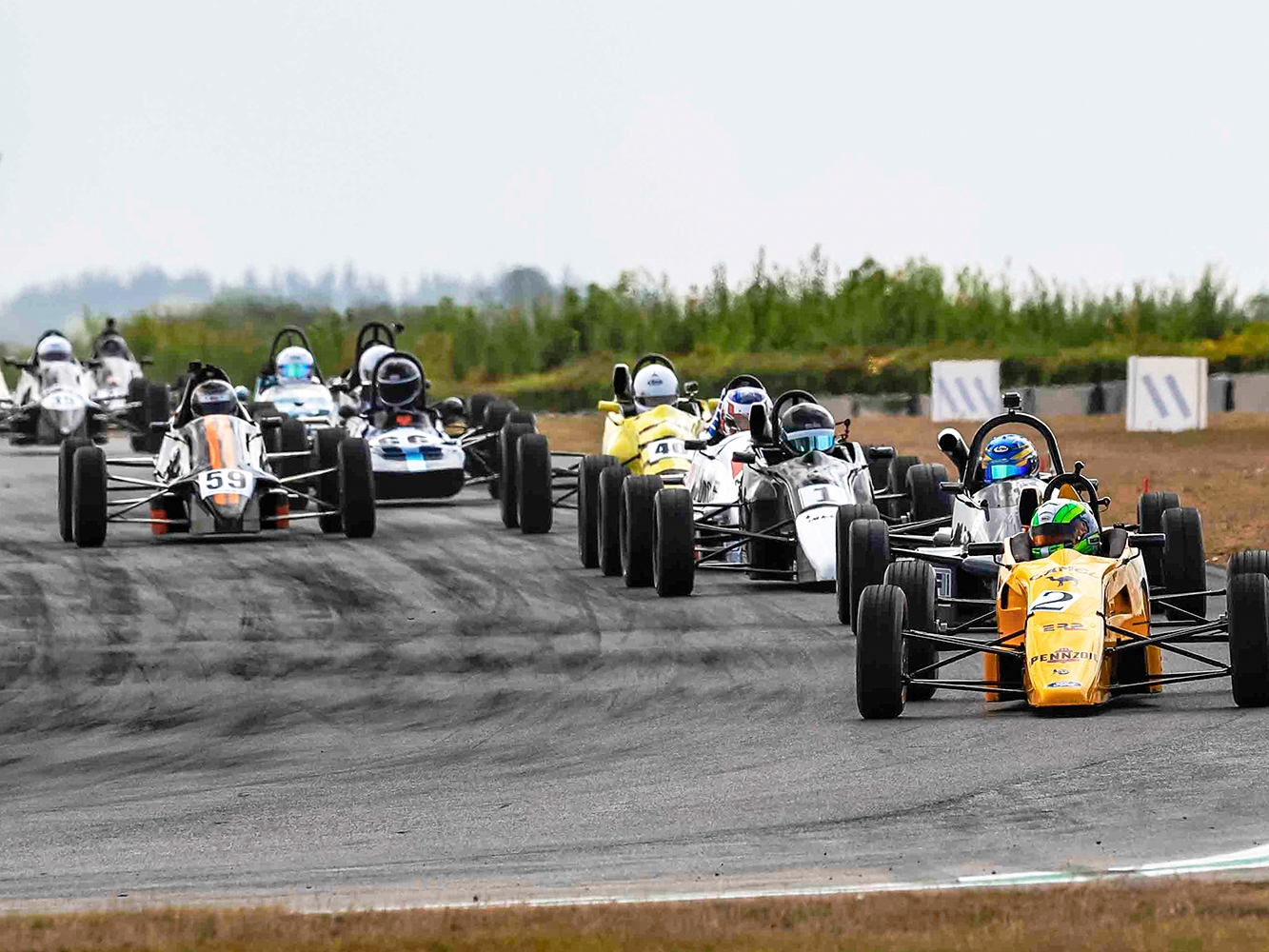
On Saturday, May 23rd, 2026, whilst supporting the British GT/GB4 meeting at Oulton Park, the United Formula Ford Championship once again delivered some standout moments from the national racing calendar:
Cresting Clay Hill, a dramatic, high-speed collision between the Race 1 leaders saw Morgan Quinn’s Van Diemen spear Rory Smith’s Medina into an inverted slew across the track (Smith fortunate to walk away unhurt). Meanwhile, less destructive battles and overtakes raged from corner to corner, producing five different podium finishers on the day, the two winners (Alex Walker and Brandon McCaughan) being GB4 graduates, both earning the results needed to develop professional careers. Meanwhile, Smith’s roll undeniably proved just how strong and safe these cars can be.
As with so many weekends of Formula Ford racing, what this one demanded, more than anything, was an audience; not just those who’d made the Easter Saturday trip to Cheshire, but nationally and beyond. The action, of which there was plenty, delivered everything a highlights reel could possibly want… Except there was no highlights reel. There was no recorded live stream either. Just a couple of sentences each from Motorsport News and Autosport, buried at the tail end of their reports. Oh, and onboard video footage from Rory Smith’s car as he was flipped out of the lead.
It’s not always like this. Pescara Productions produced a simple but effective two-race broadcast of United’s Mallory Park double header. This was another day of brilliant racing from an emerging talent pool, and it’s exactly what the community and fans need to see: They need visibility; we need visibility. I count myself in here. Formula Ford has been my life for well over 50 years; I was there in its heyday, and there during its decline. Now, I can see positive steps being taken to build a formula not only fit for purpose but fit for the times. However, what it doesn’t have is presence. Yes, twice a year, attention is focused on its two blue riband events, the Formula Ford Festival, and the Walter Hayes Trophy, but there’s a whole season’s worth of racing before then, much of which fails to garner the media support and attention needed by young aspirants.
United Formula Ford is not a struggling championship in need of charity coverage; nor is the BRSCC’s Super Classic Pre-99 grid. Indeed, earlier last week, its Donington rounds were uploaded as stand-alone races to the BRSCC’s YouTube channel. But this is such a saturated market that I believe that content is simply not enough; Formula Ford needs to reach beyond those already in its grasp.
By most measures that matter to any driver venturing into competitive motor racing (young or old), Formula Ford is, as it always has been, one of the best-value entry points in the UK. The cars are simple and affordable, the grids are close, and, as Oulton Park, Mallory Park, and the BRSCC’s weekend at Donington Park so rightly proved, the racing can be genuinely spectacular. Moreover, no matter whether you’re in a modern or classic chassis, young talent will always get a chance to shine. The problem isn’t the product. It’s that almost nobody outside a small circle of committed fans and paddock regulars gets the chance to see it. And in 2026, good racing that isn’t widely accessible is not a viable long-term position for any championship or series trying to attract the next generation of drivers, sponsors, or teams.
Three things typically separate a championship that’s visible from one that isn’t: Whether you can watch it live; whether you can watch it after the fact; and whether professional commentators choose to write about it and share their experience. Live streaming matters because it turns a curious observer into a habitual one. A viewer who can tune in from home, even to a modest fixed-camera feed, can build a relationship with a championship, driver or team that a results sheet posted to Instagram cannot. For sponsors, it also converts an abstract “this many cars race in this series” into a concrete “this many people watched last Saturday.”
Highlights packages matter for a different reason: They reach beyond the existing audience. A three-minute cut of a lead battle, or a car going airborne and its driver climbing out unhurt, is exactly the kind of clip that travels on social media to people who’ve never heard of the championship before. It’s often the single most cost-effective piece of content a small series can produce, because it’s built from footage that, if a stream exists, is already there. But highlights and re-runs also need something extra; they need to tell paddock stories, new driver introductions, and post-race celebrations (and commiserations). Some drivers are switched on to the world of social media, but at this level, they often make the simple mistake of only telling their story, and not the reason why they’re racing in Formula Ford, and why their result matters.
Press coverage is important too. Gone are the days when we waited eagerly for our weekly copies of Autosport and (as it was) Motoring News to arrive. Today, we already know what happened and why. However, these titles, especially the revamped Motorsport News, lend genuine credibility to both championships and drivers alike. A mention tells sponsors, scouts, and parents that this is a series taken seriously by people whose job is to separate signal from noise.
United Formula Ford’s visit to Oulton Park is therefore the perfect case to put these ideas to the test. In principle, all three should have been easier than usual to deliver — not harder. United Formula Ford wasn’t racing in isolation that weekend; it was sharing a paddock with British GT, GB4, and the Ginetta categories; series that between them attract dedicated cameras, a live stream, and national reporting as a matter of course. The infrastructure to capture Formula Ford’s racing was, quite literally, already on site. This is what makes the absence noticeable rather than routine. It was a support slot on one of the most visible bills on the British racing calendar; therefore, arguably, being in the exact position in which a smaller championship should expect its best chance of being seen by an audience it doesn’t normally reach.
Widen the lens beyond one weekend, and the same pattern matters for reasons that go well beyond a single missed highlights video. Sponsors don’t commit budget on the strength of good racing alone — they commit on the strength of demonstrable reach. A results sheet doesn’t help a title sponsor justify their spend to a board; what does are impressive viewing figures and a clean set of press cuttings. Young drivers entering Formula Ford need footage to build a case for presenting themselves to bigger teams and category managers further up the ladder. Of course, results count, but without the support of a demonstrative media package, a strong run in Formula Ford risks being invisible at the exact moment it should be opening doors, and this includes collective visibility; showing standout talent from a hugely competitive grid.
I’ve seen some exceptional young racers emerge from Formula Ford in my time, and I want to see more. Some from this year’s championships are already proving their ability, and the whole point of this article is that I don’t want to be one of a select few who recognises this. I’m not pointing fingers of blame: James Beckett (United Formula Ford), Alan Bowles (Super-Classic Pre-99) and Stuart Kestenbaum (SDC supported Classic Formula Ford), to mention three, put way more into their championships than they receive, and without them, Formula Ford would be in a dire state. But as a collective, I think we need to be more aligned; I think we need to be better organised; and I think we need to focus on building presence, rather than reluctantly accepting fate.
I will do my bit. I have a platform here that I will use. Transmission’s editor (Steve Hindle) has secured images from the Oulton Park rounds by Jakob Ebrey and Peter Levay, along with a short video from Peter. We will continue to tell Formula Ford’s evolving story, but I also hope that others will also see the need for the work that is required to not only preserve the category, but to grow and sustain it well into the future.
Images by Jakob Ebrey and Peter Levay: Film by Peter Levay


Oulton Park Video
Written By

Try These Next
Stories we think you'll enjoy